Thursday, March 20, 2014

Episode 21 - Competition in Gaming and Cosmic Encounter

We're talking about competition! How competitive are we and is there such a thing as too competitive? We give you those answers before moving on to our listener-chosen review, Cosmic Encounter!


We mentioned these DnDeeples in the episode. They are awesome! The large ones count as five of the smaller pieces. Head over here to take a look at Danny's work: BGG DnDeeples. Send him a Geekmail if you'd like to pimp out your Lords of Waterdeep. 


And now, for our review this week...Cosmic Encounter!


The setup for a three player game. Doesn't look all that complicated, right?


Each player will get one of these fifty aliens. Every alien has a very different power, leading to very different games.


An example of some of the aliens included in the base game.


These are your ships. The "stacking UFO" design really looks good and works functionally. 


The Destiny deck. You will draw one of these cards on your turn to determine which player you are attacking. This actually takes away some of the harshness of the game, "I didn't want to attack you, the card made me!"


These are some of the cards found in the Cosmic Deck. Attack cards and Negotiate cards are at the heart of combat, while special cards like Cosmic Zap can complicate negotiations and fights.


Some of these flair cards will be shuffled into the cosmic deck depending on the aliens in the game. Whoever draws one will be able to use a special ability. But if you manage to draw the flair card corresponding to your own alien, you will be able to use the Super part of the card. 


Episode 20 - Starting a Game Group and Letters From Whitechapel

Hello everyone! In this episode, we talk about our experience starting a game group. We also offer some vague advice on how to go about starting your own. We follow up with our review of the deduction game Letters From Whitechapel. Enjoy!


Letters from Whitechapel is a one-vs-all deduction game which pits Jack the Ripper against a team of London investigators.


The game board is an old-timey map of the Whitechapel district. Look at this board and tell me you don't feel like twirling a moustache. 


A close-up of the board. Jack will be moving from number-to-number while the police move dot-to-dot.


These are some of the pawns you will be using in the game. Notice the top-hatted Jack pieces, the white Wretched pawns and the colored policemen.


Jack will keep track of his movement on this pad behind a shield. Note the map of the boards drawn on the inside of the shield. This allows Jack to plan his move without staring directly at the board.


Setup of the game. The white tokens are placed by Jack and mark possible locations of the Wretched pawns. Black tokens are placed by the Head of Investigation and mark the possible starting locations of the police.


The board after the murder has been committed. The red token up in the top right marks the scene of the crime. The police pawns are placed on the board, and the hunt begins!


If the police do a good job, they will uncover Jack's trail. Yellow tokens mark spaces that the investigators have examined which Jack has been on at some point during the night.

Jack will use these special movement tokens to get the upper hand. The carriage allows Jack to move two spaces while the lantern allows him to move through a neighborhood. The tokens are placed on the time track to remind the investigators that they were used.


Fantasy Flight's trademark production values means that we get these tokens which are only used to randomly decide who will be head of investigation this round.


Episode 19 - Genre Spotlight: Deckbuilding and Time's Up: Title Recall

Oh Boy! In this episode of the Start Space Podcast, we give you the low-down on deckbuilding. What's it all about and what are some ones we like? We answer those questions before moving on to the hilarious party game, Time's Up: Title Recall. 


This version of Time's Up! features only titles of books, movies, television shows, etc... This makes it a bit more forgiving than the original Time's Up, which includes names of people that can be difficult to act out.


An example of a couple cards. Players will choose before the game begins whether they will use the blue or yellow side of the cards.


Everything included in the box. The simple nature of the game is what really makes it shine. 432 double-sided cards ensure that you'll never play the same game twice.

Friday, February 21, 2014

Episode 18 - First Play: Settlers of Catan and Wrath of Ashardalon

In this episode of the show, we do our first "First Play"! We look at teaching Settlers of Catan for the first time. What are some rules that are particularly hard to understand for first time players? We look to provide some tips and tricks for presenting this classic gateway for the first time. We end the episode with our customary review. This week we look at Wrath of Ashardalon and Legend of Drizzt, two games in the D&D Adventure Series. Enjoy!


Wrath of Ashardalon and The Legend of Drizzt both come from the D&D Adventure Series of games which also includes Castle Ravenloft. These games all play the same, but provide different heroes, monsters, scenarios, and cards to work with. 


Some of the hero miniatures that you might see in these games. 


Each game comes with a "boss monster". The dragon comes with Ashardalon, while the Baelor demon is in Legend of Drizzt. 


They weren't kidding around when they made these models. This comparison shot shows you exactly how much bigger the bosses are than other models.


And here is a smattering of enemy creatures. These models come in a variety of different colors which makes them easy to tell apart on the table. 


A couple of the character cards which show starting health, Armor Class, abilities, and other stats. If you manage to level up, you simply flip this card over to show your level 2 side.


Each class has a selection of cards from which to choose abilities at the start of the game. 


The game, setup for two players. The "Healing Surge" disks to the left are used if a player is killed. One disk is spent to heal the player and the game continues. If all disks are gone when a player dies, the game has been lost.


The game might look something like this after a couple of turns. Watching the dungeon expand is one of the most entertaining aspects of the game.


These decks will, in the course of a single game, destroy and rebuild you in their image.


There are some good things in the treasure deck.


But the monsters and encounters more than make up for any gains you might be able to make.


Health tokens for the players.


And some very cool health markers for the enemies. They wrap around the miniature's base so that you can easily see damage at a glance.

Wednesday, February 12, 2014

Episode 17 - Perception of the Hobby and First & Goal

In this episode of the podcast, we asked a friend of ours to be our first third chair! Together, we talk about the stereotypes and pre-conceived notions that surround tabletop gaming and review the American-football game 1st & Goal. Enjoy!


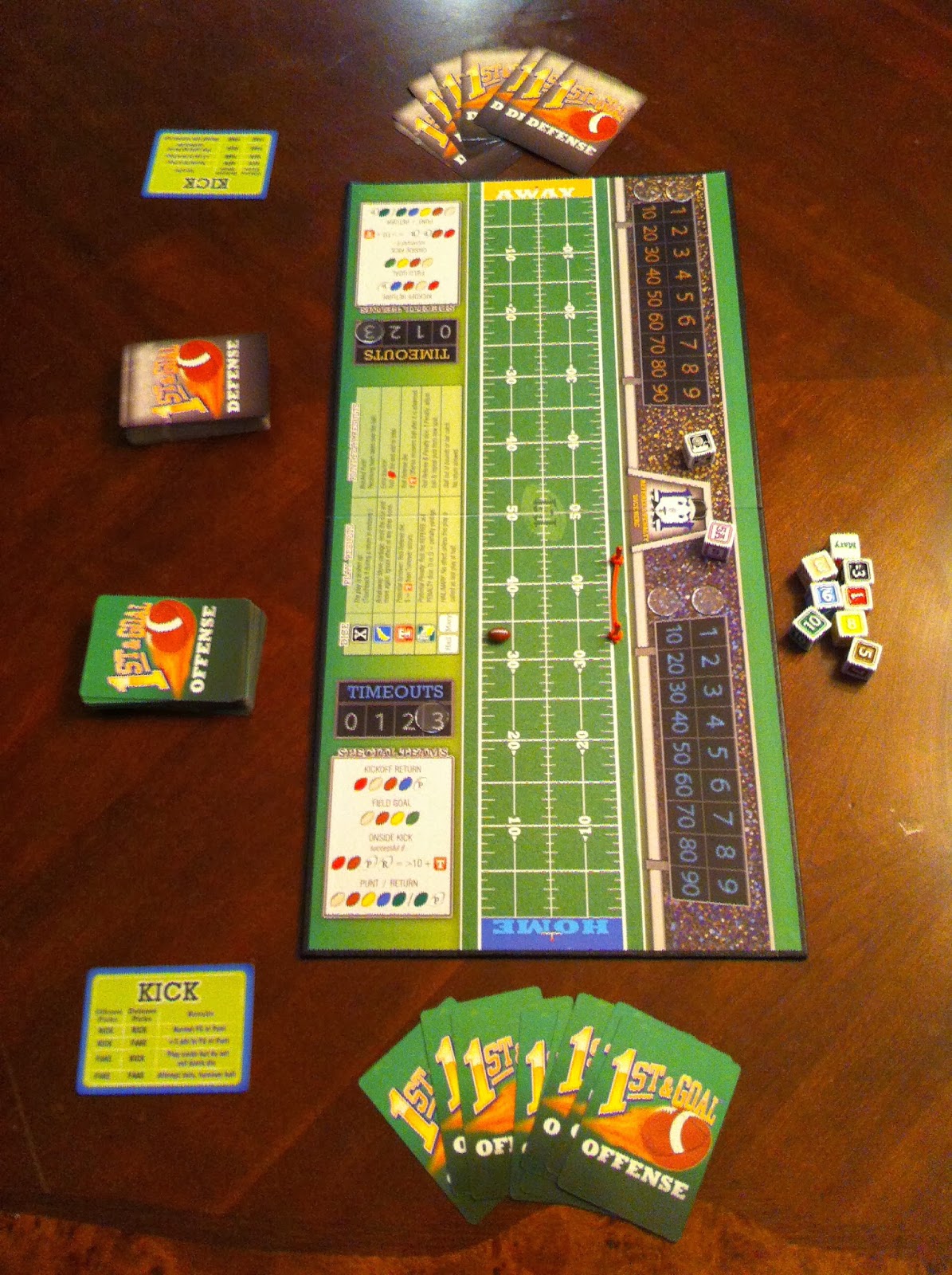
1st & Goal is a game for two to four players (but really, it's meant for two).


Here is the game, setup and ready to play. The football and yard marker pieces are magnetized and stay on the board pretty firmly. 


Running a play involves each player playing one card face-down. Compare the two cards and roll the dice shown. In the example above, the player who played Short Pass would roll one red die, the black Defense die, and the Play die against the Nickel defense.


And here are the dice! You will curse them. You will cheer them. Your fate lies in their plastic faces.


We didn't mention it in the episode, but this is how you punt/field goal. Each player has one of these cards at all times. When a kick happens, both players secretly choose either the Kick or Fake side and then compare the results.


An expansion for 1st & Goal. Each expansion adds four fictional teams with their own unique dice. This adds variety to the game as now some teams are better passers or defenders, etc.


However, unlike the current edition of the base game, expansion dice require stickers. Lots of stickers...


Sunday, February 9, 2014

Episode 16 - Playing With Two and Formula D

In this episode of the podcast, we talk about gaming with two people. What kind of games are out there for you if you've only got one constant partner? We also review the racing game Formula D!


See all that fast? You could be going that fast.


The Monaco side of the board. This is the simpler track in the box and probably the one you will be playing more often.


The red sections are turns. The number in yellow shows how many times a car must stop in the turn to avoid going too fast and overshooting the turn.


Your cars!


Your racers! Each of these drivers has a different starting car setup and special ability.


Or you could play with these generic drivers.


An example of a player's setup. The peg on the left moves to show what gear the racer is in and which die he rolls. Speaking of which...


These dice are the heart of the game. You will find yourself cursing them often.