Friday, February 21, 2014

Episode 18 - First Play: Settlers of Catan and Wrath of Ashardalon

In this episode of the show, we do our first "First Play"! We look at teaching Settlers of Catan for the first time. What are some rules that are particularly hard to understand for first time players? We look to provide some tips and tricks for presenting this classic gateway for the first time. We end the episode with our customary review. This week we look at Wrath of Ashardalon and Legend of Drizzt, two games in the D&D Adventure Series. Enjoy!


Wrath of Ashardalon and The Legend of Drizzt both come from the D&D Adventure Series of games which also includes Castle Ravenloft. These games all play the same, but provide different heroes, monsters, scenarios, and cards to work with. 


Some of the hero miniatures that you might see in these games. 


Each game comes with a "boss monster". The dragon comes with Ashardalon, while the Baelor demon is in Legend of Drizzt. 


They weren't kidding around when they made these models. This comparison shot shows you exactly how much bigger the bosses are than other models.


And here is a smattering of enemy creatures. These models come in a variety of different colors which makes them easy to tell apart on the table. 


A couple of the character cards which show starting health, Armor Class, abilities, and other stats. If you manage to level up, you simply flip this card over to show your level 2 side.


Each class has a selection of cards from which to choose abilities at the start of the game. 


The game, setup for two players. The "Healing Surge" disks to the left are used if a player is killed. One disk is spent to heal the player and the game continues. If all disks are gone when a player dies, the game has been lost.


The game might look something like this after a couple of turns. Watching the dungeon expand is one of the most entertaining aspects of the game.


These decks will, in the course of a single game, destroy and rebuild you in their image.


There are some good things in the treasure deck.


But the monsters and encounters more than make up for any gains you might be able to make.


Health tokens for the players.


And some very cool health markers for the enemies. They wrap around the miniature's base so that you can easily see damage at a glance.

Wednesday, February 12, 2014

Episode 17 - Perception of the Hobby and First & Goal

In this episode of the podcast, we asked a friend of ours to be our first third chair! Together, we talk about the stereotypes and pre-conceived notions that surround tabletop gaming and review the American-football game 1st & Goal. Enjoy!


1st & Goal is a game for two to four players (but really, it's meant for two).


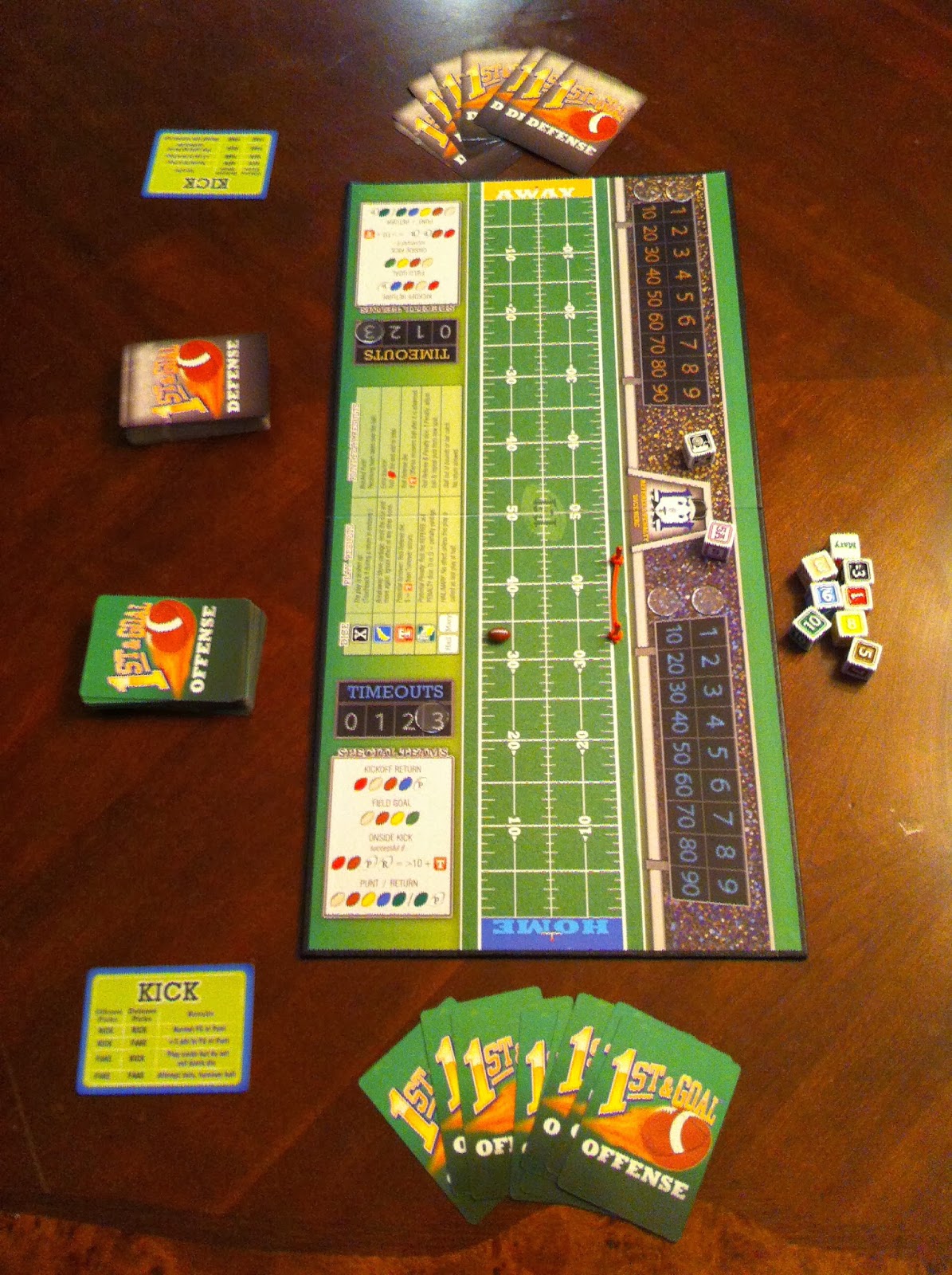
Here is the game, setup and ready to play. The football and yard marker pieces are magnetized and stay on the board pretty firmly. 


Running a play involves each player playing one card face-down. Compare the two cards and roll the dice shown. In the example above, the player who played Short Pass would roll one red die, the black Defense die, and the Play die against the Nickel defense.


And here are the dice! You will curse them. You will cheer them. Your fate lies in their plastic faces.


We didn't mention it in the episode, but this is how you punt/field goal. Each player has one of these cards at all times. When a kick happens, both players secretly choose either the Kick or Fake side and then compare the results.


An expansion for 1st & Goal. Each expansion adds four fictional teams with their own unique dice. This adds variety to the game as now some teams are better passers or defenders, etc.


However, unlike the current edition of the base game, expansion dice require stickers. Lots of stickers...


Sunday, February 9, 2014

Episode 16 - Playing With Two and Formula D

In this episode of the podcast, we talk about gaming with two people. What kind of games are out there for you if you've only got one constant partner? We also review the racing game Formula D!


See all that fast? You could be going that fast.


The Monaco side of the board. This is the simpler track in the box and probably the one you will be playing more often.


The red sections are turns. The number in yellow shows how many times a car must stop in the turn to avoid going too fast and overshooting the turn.


Your cars!


Your racers! Each of these drivers has a different starting car setup and special ability.


Or you could play with these generic drivers.


An example of a player's setup. The peg on the left moves to show what gear the racer is in and which die he rolls. Speaking of which...


These dice are the heart of the game. You will find yourself cursing them often.


Friday, January 31, 2014

Episode 15 - Designers: The Hobby Rockstars and Mage Wars

In this episode of the Start Space Podcast we pick the winners of our Love Letter contest! Then, we talk about the importance of designers in the gaming industry and review Mage Wars!


Mage Wars is a two-player card game. Think of a cross between Summoner Wars and Magic: The Gathering.


Each player chooses one of the four mages provided in the base box.


Each mage is comes with a portrait card that represents the player on the board, and a card that shows their starting stats, abilities, and attacks.


Each mage also comes with a spellbook. This is essentially your deck of cards. It contains the spells, creatures, and equipment that you will be casting throughout the game. Each player can choose cards at will from their spell book, thus eliminating the randomness of the draw.


Each player will have one of these boards to track their Channeling, Mana, and Health.


Here is the board at setup. Notice the activation markers on the two mages.


And here's what the board might look like a few turns in. Activation markers are placed on creatures as they come into play. Some cards, like the mana crystals in the top left corner, do not activate and do not need a marker.


 Attack dice. These are some really satisfying dice to roll. 


 Health and Mana markers. Health markers are used to track damage on creatures and structures. Mana tokens are used to track the mana stored by creatures and spawnpoints that can cast spells.


And finally, an example of some of the status tokens found in the game. 

Wednesday, January 22, 2014

Episode 14 - House Rules and Power Grid

In this episode, we reveal that we are now officially a member of the Dice Tower Network! After that craziness, we talk about house rules and review the classic economic-style game, Power Grid.


Following my admittedly brief rules overview, how about some pictures?


The Germany side of the board. Players will use only use one region per player, so the map becomes smaller with fewer people at the table.


 The artwork on the board is really interesting and spices up what could have been a dull map.


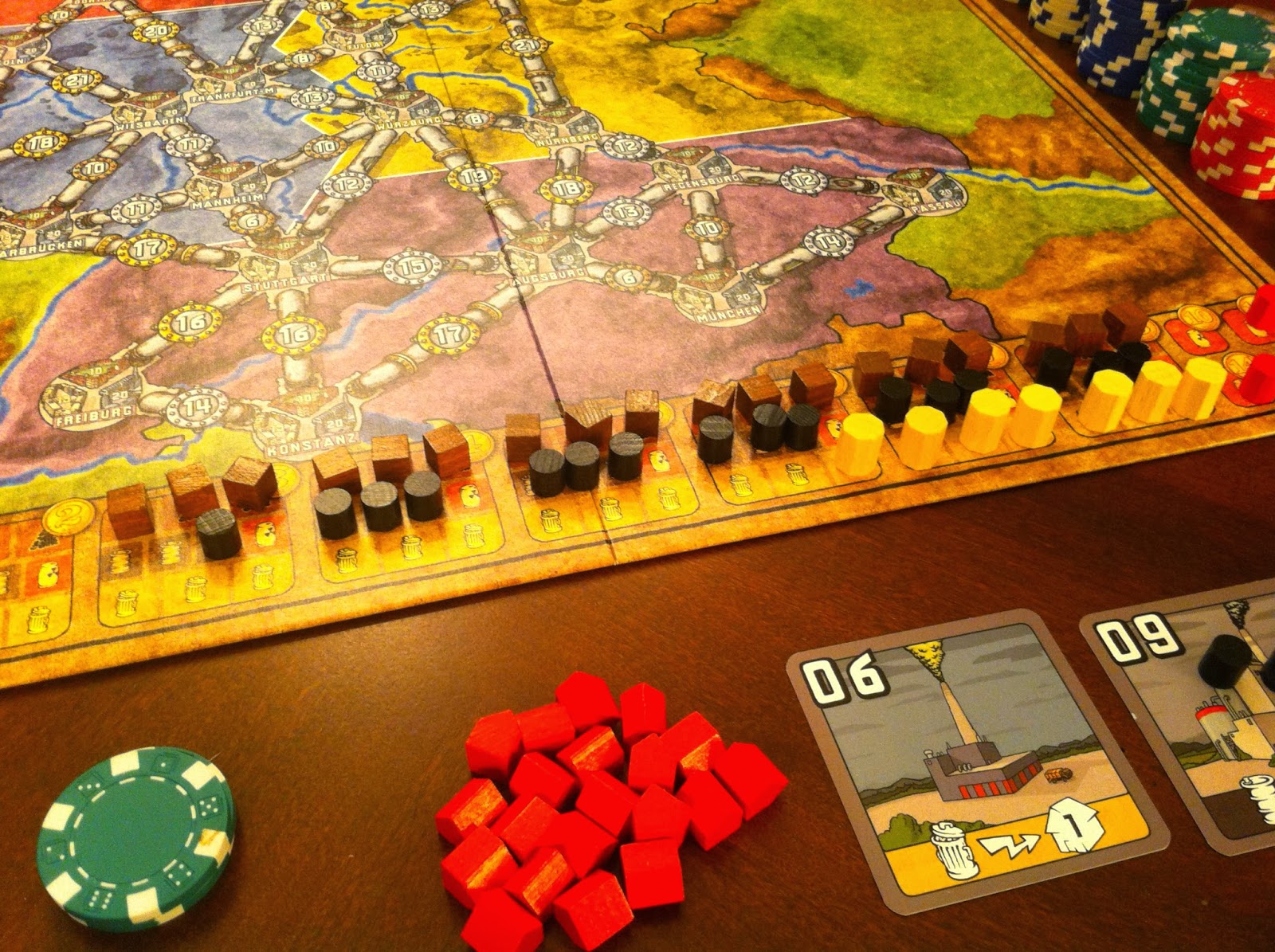
The houses which you will be placing to build out your network.


The resources you need to fuel your plants. From left to right: coal, oil, garbage, and uranium.


You'll be purchasing your resources from this track. The farther a resource is towards the left, the cheaper it is.


An example of some power plants with their resources, ready to give you the juice!


The game board a number of turns in. You really get a feel for your network growing in this game.


Ah paper money, nobody likes you...


We replaced the paper money with these superior poker chips. Huzzah!