Wednesday, February 12, 2014

Episode 17 - Perception of the Hobby and First & Goal

In this episode of the podcast, we asked a friend of ours to be our first third chair! Together, we talk about the stereotypes and pre-conceived notions that surround tabletop gaming and review the American-football game 1st & Goal. Enjoy!


1st & Goal is a game for two to four players (but really, it's meant for two).
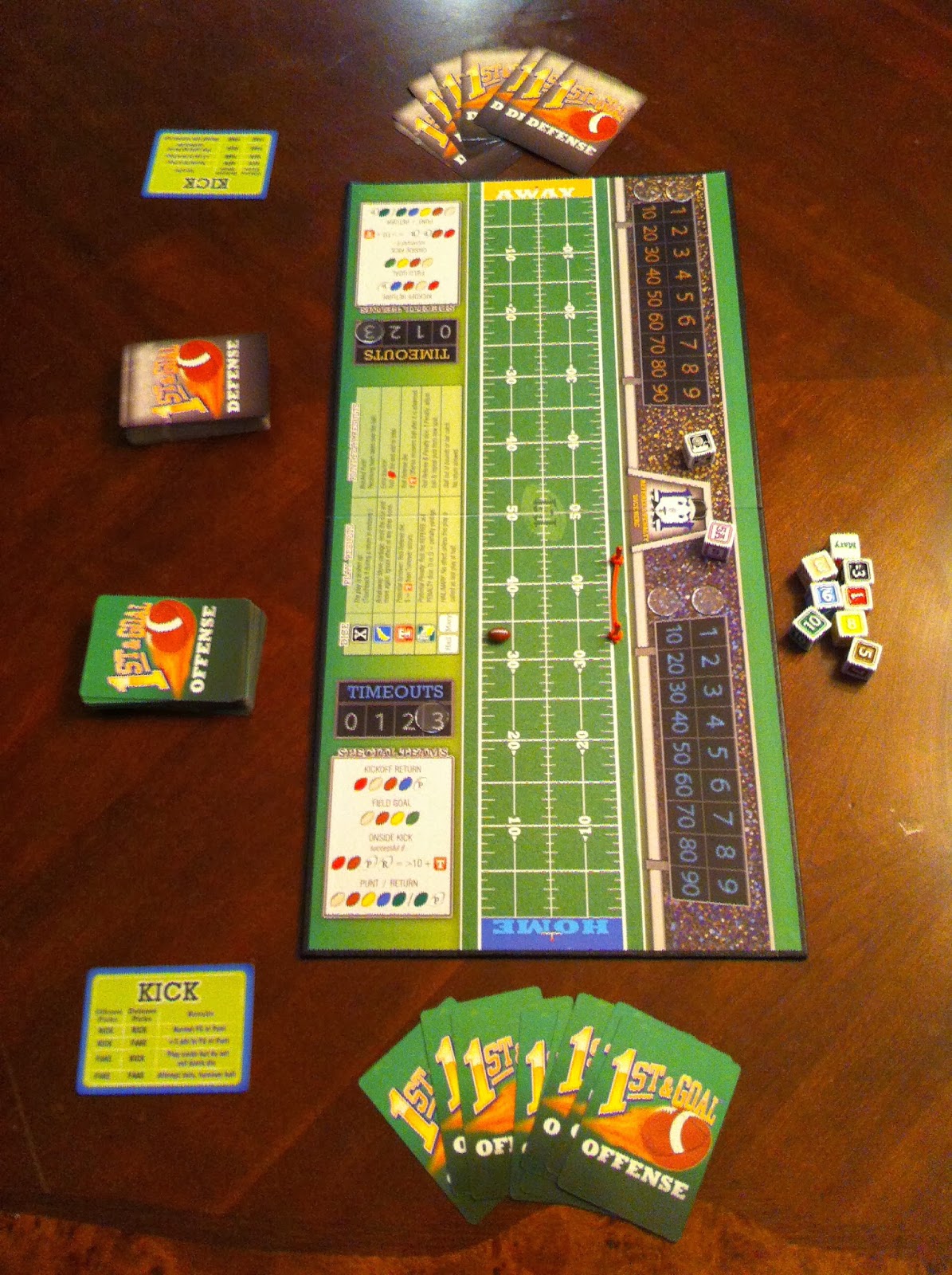

Here is the game, setup and ready to play. The football and yard marker pieces are magnetized and stay on the board pretty firmly. 


Running a play involves each player playing one card face-down. Compare the two cards and roll the dice shown. In the example above, the player who played Short Pass would roll one red die, the black Defense die, and the Play die against the Nickel defense.


And here are the dice! You will curse them. You will cheer them. Your fate lies in their plastic faces.


We didn't mention it in the episode, but this is how you punt/field goal. Each player has one of these cards at all times. When a kick happens, both players secretly choose either the Kick or Fake side and then compare the results.


An expansion for 1st & Goal. Each expansion adds four fictional teams with their own unique dice. This adds variety to the game as now some teams are better passers or defenders, etc.


However, unlike the current edition of the base game, expansion dice require stickers. Lots of stickers...


Sunday, February 9, 2014

Episode 16 - Playing With Two and Formula D

In this episode of the podcast, we talk about gaming with two people. What kind of games are out there for you if you've only got one constant partner? We also review the racing game Formula D!


See all that fast? You could be going that fast.


The Monaco side of the board. This is the simpler track in the box and probably the one you will be playing more often.


The red sections are turns. The number in yellow shows how many times a car must stop in the turn to avoid going too fast and overshooting the turn.


Your cars!


Your racers! Each of these drivers has a different starting car setup and special ability.


Or you could play with these generic drivers.


An example of a player's setup. The peg on the left moves to show what gear the racer is in and which die he rolls. Speaking of which...


These dice are the heart of the game. You will find yourself cursing them often.


Friday, January 31, 2014

Episode 15 - Designers: The Hobby Rockstars and Mage Wars

In this episode of the Start Space Podcast we pick the winners of our Love Letter contest! Then, we talk about the importance of designers in the gaming industry and review Mage Wars!


Mage Wars is a two-player card game. Think of a cross between Summoner Wars and Magic: The Gathering.


Each player chooses one of the four mages provided in the base box.


Each mage is comes with a portrait card that represents the player on the board, and a card that shows their starting stats, abilities, and attacks.


Each mage also comes with a spellbook. This is essentially your deck of cards. It contains the spells, creatures, and equipment that you will be casting throughout the game. Each player can choose cards at will from their spell book, thus eliminating the randomness of the draw.


Each player will have one of these boards to track their Channeling, Mana, and Health.


Here is the board at setup. Notice the activation markers on the two mages.


And here's what the board might look like a few turns in. Activation markers are placed on creatures as they come into play. Some cards, like the mana crystals in the top left corner, do not activate and do not need a marker.


 Attack dice. These are some really satisfying dice to roll. 


 Health and Mana markers. Health markers are used to track damage on creatures and structures. Mana tokens are used to track the mana stored by creatures and spawnpoints that can cast spells.


And finally, an example of some of the status tokens found in the game. 

Wednesday, January 22, 2014

Episode 14 - House Rules and Power Grid

In this episode, we reveal that we are now officially a member of the Dice Tower Network! After that craziness, we talk about house rules and review the classic economic-style game, Power Grid.


Following my admittedly brief rules overview, how about some pictures?


The Germany side of the board. Players will use only use one region per player, so the map becomes smaller with fewer people at the table.


 The artwork on the board is really interesting and spices up what could have been a dull map.


The houses which you will be placing to build out your network.


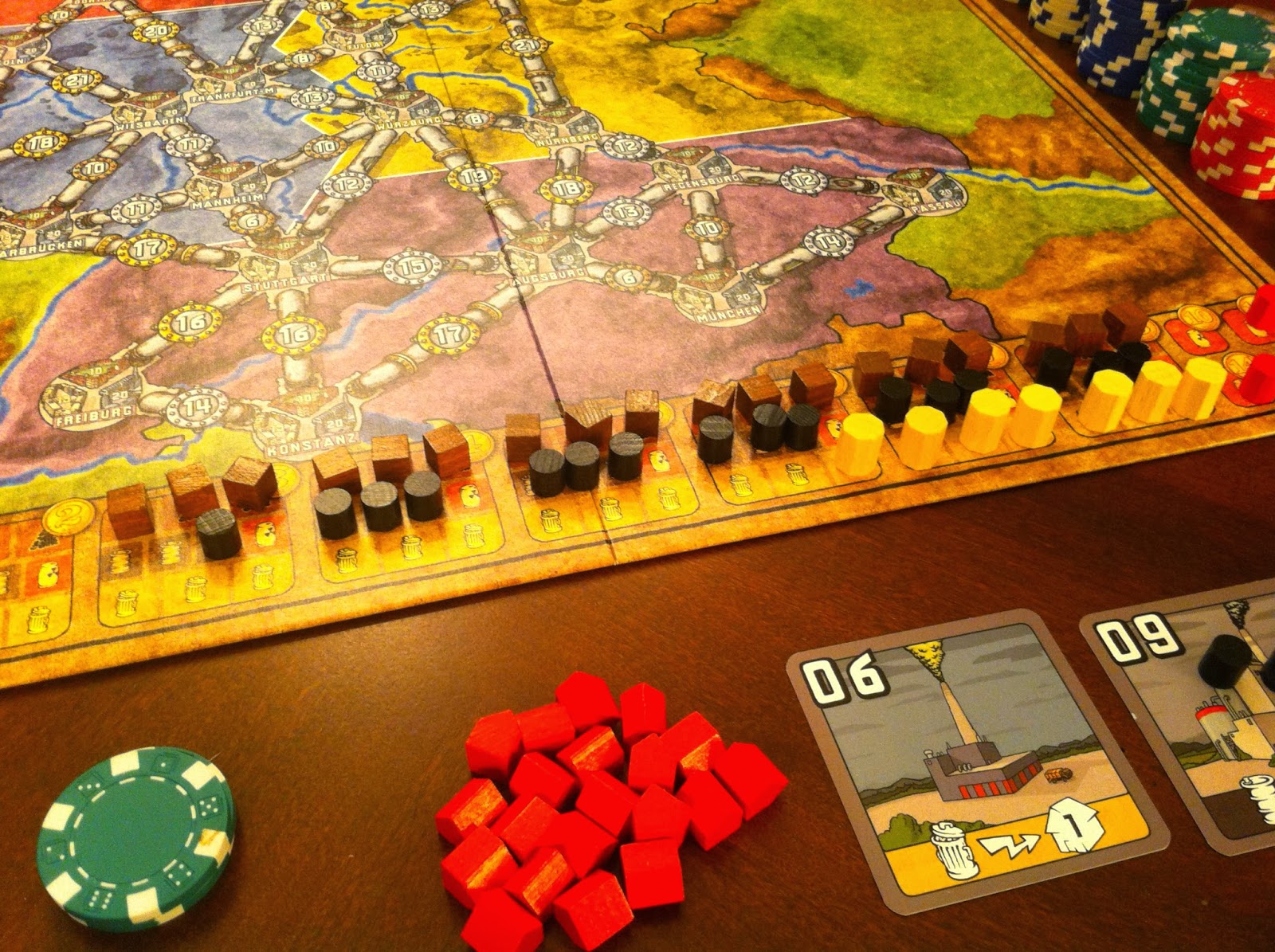
The resources you need to fuel your plants. From left to right: coal, oil, garbage, and uranium.


You'll be purchasing your resources from this track. The farther a resource is towards the left, the cheaper it is.


An example of some power plants with their resources, ready to give you the juice!


The game board a number of turns in. You really get a feel for your network growing in this game.


Ah paper money, nobody likes you...


We replaced the paper money with these superior poker chips. Huzzah!


Thursday, January 16, 2014

Episode 13 - A Contest, Abstract Games Spotlight, and Mage Knight

In this episode, we kick off our very first contest! We are giving away two copies of the awesome micro-game from AEG, Love Letter. Listen to the episode and head over here for full details: Love Letter Giveaway
Besides that, we look at the genre of Abstract games and review the super-heavy (at least for us) Mage Knight.


First off, since we did say it was a visual game, I wanted to show you some pictures of Yinsh which we discussed in the Abstract Games part of the episode.


Players start by placing their rings on the board.


Play then focuses on placing these stones in rows of the same color.


Here's what the game might look like after a number of turns. Looks neat right?


Mage Knight: The Board Game is a deep and rewarding experience.


Players will take on the role of one of these Mage Knights and conquer the countryside.


A player's starting setup. As the game progresses, This player's area will be filled with skill tiles, units and played cards.


This is the hub of the game. It includes the Advanced Action, Spell, and Unit offers along with the Day/Night board and Fame/Reputation tracks.


A close-up of the day/night board. The dice show the available mana while the number show how much movement is needed to enter the pictured terrain during this round.


 The starting map. The starting tile is always the same, but the two connected tiles are drawn randomly. You can see that we've already uncovered a wizards tower, a fortress, and a rampaging orc.


An example of some of the monsters you might see in this game. You will be referencing the rulebook often at first to decipher the iconography on these tokens.


Mana crystals. Do not leave these on the floor if you walk around barefoot.


The cities that are the objective in most scenarios. These models use the Wiz-Kids patented clix bases to show the level of the city.


There are quite a few tokens and pieces in this game.